


Language switcher
Rise to the challenge?
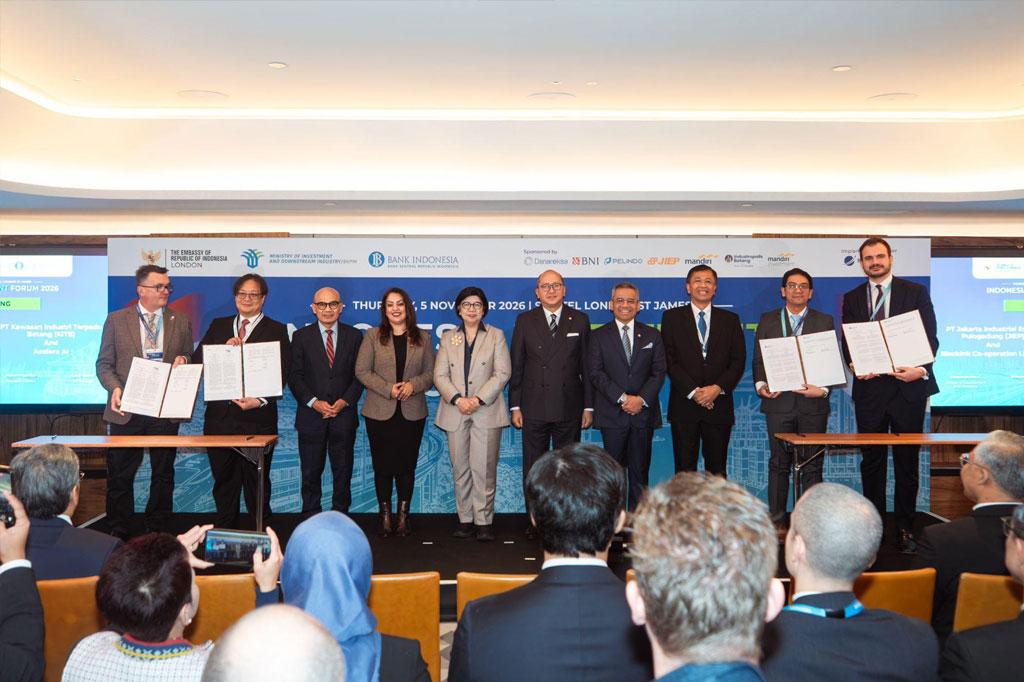
LONDON, 11 November 2026 — Indonesia is encouraging partnerships with UK and European businesses and investors to develop its industrial, manufacturing, infrastructure, and logistics sectors, as part of efforts to strengthen the country’s position in regional and global supply chains. These opportunities were the focus of the Indonesia Investment Forum (IIF) 2026, held in London on 5 November, which brought together government representatives, financial institutions, and business leaders to explore investment opportunities and commercial cooperation in Indonesia.
Under the theme Fostering Resilient Investment Through a Robust Supply Chain, IIF 2026 was attended by approximately 100 delegates from industry, banking, and government authorities. The forum took place within the context of the UK-Indonesia Economic Growth Partnership, which provides opportunities to strengthen trade and investment relations between the two countries.
The forum resulted in three strategic agreements, comprising two Memoranda of Understanding (MoUs) and one Letter of Intent (LoI), with total investment commitments of approximately US$385.1 million. These commitments reflect interest in various productive sectors in Indonesia.
Rosan Perkasa Roeslani, Minister of Investment and Downstream Industry/Head of BKPM, emphasised that the objectives of investment should be assessed based on the economic benefits generated, including their impact on society.
“From January to September, our realised direct investment reached approximately US$93 billion, growing by 7.3% and creating around 2.2 million jobs in Indonesia. For us, it is not about owning the assets. It is about how those assets deliver a significant and positive impact on society,” he stated.
The total investment commitments of US$385.1 million, comprise three main projects. First, Titanium Capital’s planned investment of US$252.1 million in the tin processing sector. Second, Axelera’s US$56 million investment in the development of an artificial intelligence (AI)-based data centre at the Industropolis Batang Special Economic Zone.
The third investment commitment comes from BlackInk Co-operation Limited, amounting to US$77 million, for the development of heavy equipment and spare parts assembly facilities at the Jakarta Industrial Estate Pulogadung (JIEP). JIEP offers opportunities for logistics development and multifunctional areas on land under its management in Pulogadung, including a transit-oriented development concept that is still undergoing a feasibility study.
Beyond the investment commitments announced at the forum, IIF 2026 also provided momentum to expand industrial cooperation between Indonesia and the United Kingdom. One such initiative was the signing of a MoU between PT Pelabuhan Indonesia (Persero), or Pelindo, and the Society of Maritime Industries (SMI), facilitated by Equatorise Advisory as the local partner.
The MoU establishes a framework for exploring cooperation between Pelindo and the UK port industry through the Ports and Terminals Group (PTG) under SMI, focusing on the sustainable development, modernisation, and operation of Indonesia’s ports and maritime infrastructure.
The three initial areas of cooperation being explored include port infrastructure and modernisation, smart ports and digitalisation, and green ports and decarbonisation. Through SMI’s network of maritime, engineering, and port technology companies, the cooperation is expected to connect Pelindo’s needs with British industry expertise to support Indonesia’s connectivity and supply chain resilience. Identified opportunities for commercial and technical cooperation will be followed up through separate agreements between the relevant parties.
Desra Percaya, Indonesian Ambassador to the United Kingdom, highlighted the contribution of Special Economic Zones (SEZs) to business activity and employment opportunities. He noted that 25 Special Economic Zones have attracted approximately US$21 billion in investment, brought in more than 500 companies, and created 30,000 jobs. These figures reflect the development of Special Economic Zones nationwide.
“Investment opportunities exist at every stage of the supply chain, from farms and factories to ports and markets. However, credibility must come before investment, and consistency builds trust,” he stated.
Steven Marcelino, Managing Partner and CEO of Equatorise, explained that many projects capable of strengthening supply chains still need to be connected with partners possessing the capacity and expertise required to meet each project’s specific needs.
“Indonesia has various projects with clear commercial potential. However, turning these opportunities into actionable partnerships requires expertise and industry networks that understand local needs. Our role is to bridge this gap by connecting project owners in Indonesia with international partners who have the capacity to advance project development,” Steven stated.
Similarly, Minister of Finance Suahasil Nazara outlined several fiscal strategies for 2027 that could strengthen the investment climate. These include strengthening a fair and reliable taxation system, improving the quality of government spending, and directing resources towards the highest-priority needs. They also include developing more innovative financing mechanisms to maintain fiscal resilience and attract additional development capital.
“Fiscal policy is about managing the budget in a way that promotes economic growth and protects society. At the same time, fiscal policy must remain credible to fulfil all its functions,” he stated.
Destry Damayanti, Governor of Bank Indonesia, explained concrete measures to help investors manage foreign exchange risks. In 2026, Bank Indonesia expanded hedging incentives to include foreign direct investment and banks’ external borrowing. Reductions in Domestic Non-Deliverable Forward (DNDF) premiums reached 40% for six-month tenors and 45% for 12-month tenors, with extension facilities of up to three years.
“This resilience did not happen by chance. It is the result of a consistent policy mix and close synergy between Bank Indonesia and the government. We want international capital to enter, remain, and grow,” she explained.
Meanwhile, Naz Shah MP, the UK Prime Minister’s Trade Envoy to Indonesia and ASEAN, emphasised the potential for economic cooperation to deliver long-term benefits for both countries.
“We can support resilient growth and deliver long-term benefits for both countries,” she stated.
The forum was jointly organised by the Ministry of Investment and Downstream Industry/BKPM through IIPC London, the Embassy of the Republic of Indonesia in London, and the Bank Indonesia Representative Office in London.
About Equatorise
Equatorise is an international advisory firm that supports Indonesian companies in pursuing opportunities in the United Kingdom and European Union, while also helping UK- and EU-based companies and institutions expand into Indonesia. We help companies develop emerging opportunities across two key areas: digital transformation and the sustainable transition, with the ambition of achieving net-zero emissions.

2025 © Equatorise. All rights reserved. Website by Stand Studio